Install Findmino as an app for the best experience!
Biomedical Engineer
(BME Specialist, Medical Device Engineer, Biomedical Technology Engineer, Clinical Engineer)
Engineering & Manufacturing
Salary
€38,000 - €90,000/yr
Level
Professional
Outlook
Growing
Sector
Engineering & Manufacturing
What does a Biomedical Engineer do?
Biomedical Engineers combine engineering principles with biological and medical sciences to design, develop, and test medical devices, diagnostic equipment, implants, and healthcare technologies. Day-to-day work can involve prototyping new devices, running laboratory tests, analysing biological data, and ensuring products meet strict regulatory and safety standards. You collaborate closely with medical professionals, research scientists, manufacturing teams, and regulatory affairs specialists. Many biomedical engineers in Ireland work within the thriving medical technology sector, contributing to products used by patients worldwide. The role sits at the intersection of innovation and patient welfare, making technical precision and ethical responsibility equally important.
A Day in the Life
Listen: a day as a Biomedical Engineer
You arrive at the medical device company's facility on the outskirts of Galway at 7.45 a.m., badge in at the security desk and head straight to your locker to change into your lab coat and ESD-safe footwear before entering the cleanroom area. The company manufactures minimally invasive surgical instruments, and your first task is reviewing overnight test data from a batch of prototype catheter tips that the technicians ran on the tensile-testing machine the previous evening. Two samples fell below the specified pull-force threshold, so you log the non-conformance in the company's quality management system and flag it for the morning stand-up. At 9.00 a.m. you join the cross-functional stand-up with colleagues from R&D, manufacturing and regulatory affairs. You walk through your non-conformance findings and agree with the regulatory affairs specialist that the issue needs a root-cause investigation before the next design-verification test cycle can proceed. This delays a milestone, which nobody is pleased about, but it is the honest and compliant thing to do under the EU Medical Device Regulation.
Videos about Biomedical Engineer
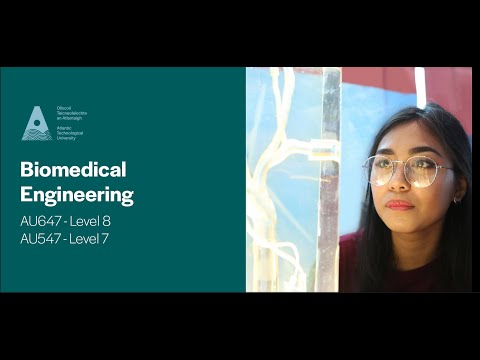
AU647 & AU547 - BEng (Hons) in BioMedical Engineering and BEng in Biomedical Engineering
ATU Galway City
Required Education
A Level 8 Honours Bachelor degree in Biomedical Engineering is the typical entry point; programmes are offered at University of Galway, University of Limerick, and TU Dublin, among others. Leaving Certificate subjects that strengthen your application include Mathematics, Physics, Biology, and Chemistry, as these underpin core engineering and life-science modules. Some graduates pursue a Level 9 Masters or structured PhD (Level 10) to specialise in areas such as biomaterials, medical imaging, or tissue engineering. PLC courses in Science or Engineering Technology at Level 5–6 can provide a bridging route into undergraduate programmes via the QQI Higher Education Links scheme. While there is no single statutory regulator for biomedical engineers, professional membership with Engineers Ireland (Chartered Engineer status) is widely valued by employers and supports career progression. Relevant postgraduate diplomas and Springboard+ funded programmes are also available for those upskilling or changing specialisation.
Required Skills
Career Perspective
Graduates typically begin as Junior or Graduate Biomedical Engineers within a medical device company or research institution, working under supervision on defined project tasks and building familiarity with regulatory processes. After several years of experience, progression to a Senior Engineer role is common, involving greater autonomy in design decisions, project leadership, and mentoring of junior colleagues. Many engineers then move into specialist streams such as R&D, regulatory affairs, quality systems, or clinical applications, or advance into management positions such as Engineering Manager or Director of R&D. Achieving Chartered Engineer status through Engineers Ireland strengthens prospects for senior and international roles, and some professionals transition into academia or clinical engineering within the HSE.
AI Impact on the job
Artificial intelligence is increasingly being applied to medical device development, with machine-learning algorithms accelerating the analysis of biological data, supporting predictive modelling in device testing, and improving the precision of diagnostic imaging systems that biomedical engineers help design. AI-assisted design tools are also reducing iteration times during the prototyping phase, allowing engineers to evaluate more design variants in shorter timeframes. However, the safety-critical and heavily regulated nature of medical devices means that human engineering judgement, ethical oversight, and regulatory expertise remain indispensable. Biomedical engineers who develop competency in data science and AI-integrated design workflows will be particularly well-positioned in the evolving Irish med-tech landscape.
Career Ladder
→ Biomedical Engineer (Current role)
Related Studies
Employers in Ireland
Organisations in Ireland that employ people in this occupation.
Galway, Co. Galway
Design and manufacture cardiac, surgical and neuromodulation medical devices.
Clonmel, Co. Tipperary; Galway, Co. Galway
Develop and test minimally invasive cardiovascular and endoscopy devices.
Clonmel, Co. Tipperary; Kilkenny, Co. Kilkenny
Engineer diagnostic equipment and vascular medical devices at scale.
Limerick, Co. Limerick; Letterkenny, Co. Donegal
Design and validate endovascular and interventional medical devices.
Cork, Co. Cork; Limerick, Co. Limerick
Develop orthopaedic implants, surgical instruments and patient handling systems.
Galway, Co. Galway
Engineer minimally invasive delivery systems and catheter-based medical devices.
Nationwide
Manage clinical engineering, medical device maintenance and hospital technology.
Galway, Co. Galway
Research and prototype next-generation implantable and diagnostic technologies.
Galway, Co. Galway
Develop smart diagnostic devices for gastrointestinal and oesophageal conditions.
Athlone, Co. Westmeath; Dublin
Design and manufacture vascular access and anaesthesia medical devices.
Ballina, Co. Mayo
Engineer ostomy, continence and wound care medical device products.
We don't know whether these employers currently have vacancies — always check their own website. And if there's somewhere you'd really love to work, it can be worth applying anyway, even without an open vacancy.
Our tools can help you with that:
This website uses cookies
We use functional cookies and — with your consent — cookies for preferences, statistics and marketing.