Install Findmino as an app for the best experience!
Physiotherapy Assistant
(Therapy Assistant, Physiotherapist Assistant, Physiotherapy Rehabilitation Assistant, Healthcare Support Worker (Physiotherapy))
Health & Social Care
Salary
€28,000 - €38,000/yr
Level
Operational
Outlook
Stable
Sector
Health & Social Care
What does a Physiotherapy Assistant do?
As a Physiotherapy Assistant you work alongside chartered physiotherapists in hospitals, rehabilitation centres, and private clinics, helping patients recover from injury, illness, or surgery. Your day-to-day tasks include assisting patients with prescribed exercises, setting up and maintaining therapeutic equipment, and monitoring patient progress under the supervision of a qualified physiotherapist. You collect and record client data, help patients move safely, and provide encouragement and support throughout their rehabilitation journey. You work as part of a wider multidisciplinary team that may include occupational therapists, nurses, and doctors, always following agreed treatment protocols and referring decisions to the supervising physiotherapist.
A Day in the Life
Listen: a day as a Physiotherapy Assistant
You arrive at the physiotherapy department of a busy HSE general hospital at 7:45 on a Tuesday morning, fifteen minutes before your shift officially starts. You check the whiteboard in the staff room, which lists the patients scheduled for the day across the orthopaedic and respiratory wards. Your supervising chartered physiotherapist, who holds an Honours Bachelor degree and is registered with CORU, runs through the morning list with you, flagging a post-operative hip-replacement patient who needs extra care when transferring from bed to standing. By 8:30 you are on the orthopaedic ward, introducing yourself to a man in his sixties who had surgery three days ago. You follow the treatment protocol the physiotherapist has written in the patient's chart, guiding him through a set of ankle pumps and gentle knee bends designed to prevent blood clots and restore movement. You use a gait belt around his waist to keep him safe as he takes his first steps with a Zimmer frame. Progress is slow and he is nervous, so a lot of your work is simply reassuring him that discomfort is normal.
Videos about Physiotherapy Assistant
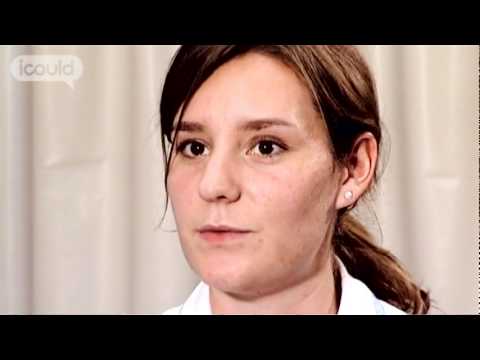
Career Advice on becoming a Physiotherapist by Megan F (Highlights)
icould career stories
Some videos were filmed in the UK. The work itself is the same, but the exams, qualifications and pay they mention are British — we include them so you get a feel for the job.
Required Education
A QQI Level 5 Certificate in Healthcare Support or a related healthcare award from a College of Further Education is the typical entry route for this role in Ireland. Relevant Leaving Certificate subjects include Biology, Chemistry, Physical Education, and English, all of which build useful background knowledge. Many candidates complete a PLC course at their local Education and Training Board (ETB) college, which often includes a practical work placement in a healthcare setting. Some employers in the HSE or private sector accept applicants with a QQI Level 6 award in Health Service Skills or a related discipline, which can strengthen your application. There is no statutory registration requirement with CORU for physiotherapy assistants at present, but registration requirements for the wider profession may influence workplace standards and supervision arrangements. Relevant CPD and in-house training are typically provided once you are employed.
Required Skills
Career Perspective
Most physiotherapy assistants begin their careers after completing a QQI Level 5 or Level 6 healthcare qualification, taking up entry-level posts in HSE hospitals, community health settings, or private physiotherapy clinics. With experience, you may take on greater responsibility within your assistant role, supervise other support staff, or specialise in a particular clinical area such as neurological or musculoskeletal rehabilitation. Many physiotherapy assistants choose to progress by returning to full-time or part-time education, undertaking an NFQ Level 8 Honours Bachelor degree in Physiotherapy through the CAO, which leads to qualification as a Chartered Physiotherapist. Continuous professional development and in-service training are important throughout your career, whether you remain in an assistant role or progress to professional qualification.
AI Impact on the job
Artificial intelligence is beginning to influence physiotherapy practice through tools that support exercise monitoring, patient data analysis, and remote rehabilitation platforms. For physiotherapy assistants, AI-powered apps and sensor-based systems may assist in tracking patient movement and progress, potentially making some data-collection tasks more efficient. However, the hands-on, person-centred nature of the assistant role — supporting and encouraging patients physically and emotionally — means that direct human involvement remains essential and cannot be replicated by technology. Familiarity with digital health records and emerging rehabilitation technologies will become increasingly useful for physiotherapy assistants working in modern clinical environments.
Career Ladder
→ Physiotherapy Assistant (Current role)
Related Studies
Employers in Ireland
Organisations in Ireland that employ people in this occupation.
Nationwide
Assists physiotherapists in HSE hospitals and community care settings.
Dublin 4
Supports physio teams in acute and rehabilitation wards.
Dún Laoghaire, Co. Dublin
Helps patients regain mobility in specialist rehabilitation programmes.
Dublin, Cork, Galway, Limerick, Tralee
Supports physiotherapists in private hospital therapy and recovery units.
Nationwide
Assists physiotherapists across primary care and GP-linked clinics.
Kildare, Laois, Offaly, Westmeath
Supports therapy teams for people with intellectual disabilities.
Nationwide
Assists physios delivering rehabilitation for people with disabilities.
Dublin, Cork
Supports physiotherapy teams in orthopaedic and surgical recovery.
Nationwide
Assists physiotherapists supporting children and adults with disabilities.
Cork city and county
Helps deliver physiotherapy support to adults with disabilities.
We don't know whether these employers currently have vacancies — always check their own website. And if there's somewhere you'd really love to work, it can be worth applying anyway, even without an open vacancy.
Our tools can help you with that:
This website uses cookies
We use functional cookies and — with your consent — cookies for preferences, statistics and marketing.