Install Findmino as an app for the best experience!
Plasterer
(Wall Finisher, Solid Plasterer, Fibrous Plasterer, Renderer)
Construction & Trades
Salary
€30,000 - €60,000/yr
Level
Operational
Outlook
Growing
Sector
Construction & Trades
What does a Plasterer do?
As a Plasterer you apply plaster, render and other finishing materials to interior and exterior walls, ceilings and surfaces on residential, commercial and civil construction projects. Your daily work involves mixing plaster compounds, preparing surfaces, applying coats of plaster or render, and smoothing finishes to the required standard before the material sets. You may also carry out dry lining, install insulation boards and apply specialist coatings or decorative stucco work on heritage buildings. You work closely with bricklayers, carpenters, site managers and other trades, and are expected to read drawings, follow specifications and maintain a tidy, safe working environment at all times.
A Day in the Life
Listen: a day as a Plasterer
You are up at 6.15 on a Tuesday morning and on site in a new-build housing estate outside Athlone by 7.30. The site manager holds a brief toolbox talk — a short safety briefing — where he reminds everyone about PPE requirements and the wet weather forecast. You sign the attendance sheet, pull on your hard hat and steel-toe boots, and head to the block of houses where internal plastering is under way. Your first task is mixing a batch of sand-and-cement scratch coat — the first layer applied to block walls — in the electric paddle mixer. You get the water-to-powder ratio right by feel and by reading the specification sheet clipped to your work bag. Consistency matters: too wet and the plaster slumps; too dry and it will crack. You haul the loaded bucket to the first-floor bedroom and begin applying the scratch coat with a hawk and float, pressing the mix firmly onto the block surface and ruling it flat with a darby, a long aluminium straightedge.
Videos about Plasterer
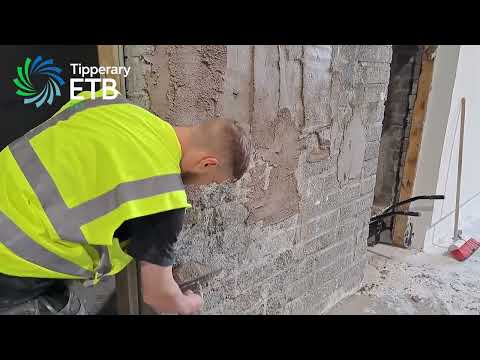
Plastering Traineeship at Tipperary ETB's Construction Skills Training Centre
Tipperary ETB
Required Education
Entry to the trade is most commonly through the SOLAS Plastering apprenticeship, which is an earn-and-learn programme typically lasting four years and leading to a NFQ Level 6 Advanced Certificate in Craft. Leaving Certificate subjects such as Construction Studies, Engineering, and Mathematics are useful preparation, though a full Leaving Certificate is not always mandatory for apprenticeship entry, provided you meet the employer and SOLAS requirements. Some candidates begin with a QQI Level 5 Construction Skills or Plastering course at a College of Further Education before seeking an apprenticeship employer. The apprenticeship combines on-the-job training with off-the-job phases at an Education and Training Board (ETB) training centre or Institute of Further Education. There is no statutory professional registration body specific to plasterers in Ireland, but Safe Pass certification and manual handling training are required on Irish construction sites.
Required Skills
Career Perspective
Most plasterers begin as apprentices under a SOLAS registered employer, progressing through the four stages of the apprenticeship before qualifying as a craftsperson at NFQ Level 6. After qualification, you typically work as a journeyperson on larger residential or commercial sites, building speed, versatility and a reputation for quality. With experience, many plasterers move into self-employment or subcontracting, managing small teams and tendering for their own work, while others progress to site foreperson or contracts supervisor roles. Specialist areas such as heritage and conservation plastering, external insulation finish systems (EIFS) or decorative fibrous plasterwork offer valuable niche opportunities with premium rates.
AI Impact on the job
AI and automation have limited direct impact on the day-to-day work of a plasterer, as the physical skill of applying and finishing plaster to varied surfaces remains difficult to replicate with machines. Estimating and project management software increasingly assists with quoting and scheduling, making basic digital literacy useful for self-employed plasterers. Robotic plastering machines are being piloted on large commercial projects abroad, but widespread adoption on Irish sites is not expected in the near term given cost and site complexity. Overall, the hands-on, adaptive nature of the trade means it is among the less exposed construction occupations to AI-driven displacement.
Career Ladder
→ Plasterer (Current role)
Employers in Ireland
Organisations in Ireland that employ people in this occupation.
Nationwide
Plasterers work on major commercial and residential construction projects.
Dublin and Nationwide
Plastering and dry lining on large-scale civil and commercial builds.
Dublin and Nationwide
Interior and exterior plastering across residential and commercial projects.
Dublin and Nationwide
Specialist dry lining, plastering and interior fit-out contractor.
Nationwide
Plasterers finish interior walls and ceilings on large housing developments.
Cork City
Plasterers carry out maintenance and refurbishment of public housing stock.
Dublin City
Plastering and rendering on social housing repair and upgrade programmes.
Dublin and Nationwide
Plasterers apply finishes across high-volume residential housing schemes.
Nationwide
Heritage plastering and stucco restoration on historic State buildings.
Thurles, Co. Tipperary and Nationwide
Plastering trades employed across commercial and public-sector builds.
Galway
Specialist plastering, rendering and dry lining on regional projects.
We don't know whether these employers currently have vacancies — always check their own website. And if there's somewhere you'd really love to work, it can be worth applying anyway, even without an open vacancy.
Our tools can help you with that:
This website uses cookies
We use functional cookies and — with your consent — cookies for preferences, statistics and marketing.