Install Findmino as an app for the best experience!
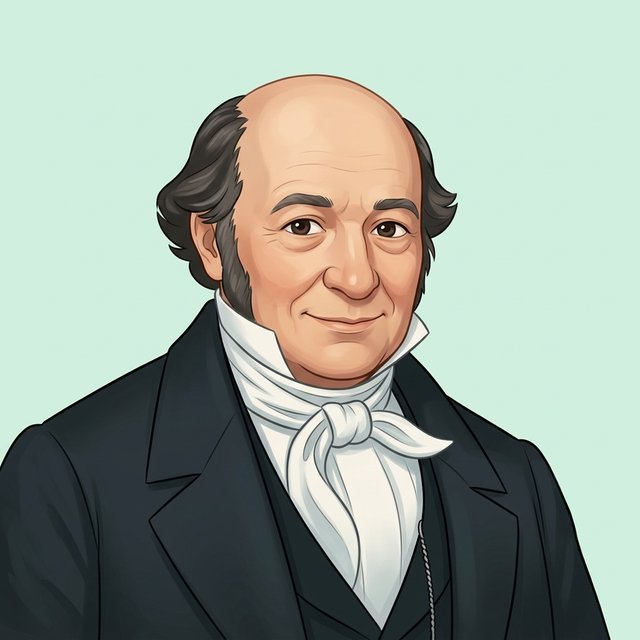
Mathematician
William Rowan Hamilton
Dublin mathematician, inventor of quaternions.
Education
William Rowan Hamilton was born in Dublin in 1805 and showed extraordinary academic ability from a very young age. By his early teens he had taught himself more than a dozen languages and was devouring advanced mathematics entirely on his own. He entered Trinity College Dublin at just eighteen, excelling so brilliantly that he was appointed Professor of Astronomy there before he had even graduated. His formal education was built on a foundation of fierce personal curiosity — he never waited to be taught something if he could figure it out himself.
Career
Hamilton spent his career at Trinity College Dublin and the Dunsink Observatory, pushing the boundaries of mathematics and physics in directions nobody had gone before. He reformulated the laws of mechanics in a way so powerful that physicists still use 'Hamiltonian' equations today in quantum mechanics and relativity. His greatest breakthrough came in 1843 when, on a walk along the Royal Canal in Dublin, he suddenly grasped the concept of quaternions — a new kind of number system — and famously carved the key equation into the stone of Broome Bridge. It was a moment of pure inspiration after years of stubborn, patient thinking.
Key Lesson
Hamilton's story shows that deep curiosity and the willingness to sit with a hard problem for a long time are more powerful than any shortcut. You don't need to be in a big city or a famous lab to change the world — Hamilton did it walking along a Dublin canal. Whatever subject fires you up, follow it seriously, because today's abstract idea can become tomorrow's essential technology.
Careers like this on Findmino
Which celeb are you most like?
Take the 5-minute swipe quiz and discover your own celebrity matches.
This website uses cookies
We use functional cookies and — with your consent — cookies for preferences, statistics and marketing.