Install Findmino as an app for the best experience!
Air Corps Technician
(Aircraft Maintenance Technician, Aviation Maintenance Technician, Avionics Technician, Airworthiness Technician)
Law & Public Service
Salary
€28,000 - €55,000/yr
Level
Operational
Outlook
Stable
Sector
Law & Public Service
What does an Air Corps Technician do?
As an Air Corps Technician you maintain, inspect and repair military aircraft operated by the Irish Air Corps, working across airframes, engines and avionics systems. Your daily work involves carrying out scheduled and unscheduled maintenance checks, diagnosing faults using technical documentation and instrumentation, and ensuring every aircraft meets strict airworthiness standards before flight. You work closely with fellow technicians, engineers and aircrew at Casement Aerodrome in Baldonnell, County Dublin, or at other Air Corps bases and detachments. Safety and precision are at the core of everything you do, as your work directly affects the lives of aircrew and the operational readiness of the Defence Forces.
A Day in the Life
Listen: a day as an Air Corps Technician
Your alarm goes off at 06:15. You are based at Casement Aerodrome in Baldonnell, County Dublin, and need to be on the flight line by 07:30 for the morning brief. You pull on your olive-green coveralls, check your toolbox is locked and accounted for, and head in. The shift brief covers which aircraft are scheduled to fly today, any outstanding defects from yesterday and the jobs each team is taking on. Your section leader assigns you to a CN-235 maritime patrol aircraft that is due a 200-hour periodic inspection. You collect the relevant maintenance manual from the technical library and sign out your calibrated torque wrenches and inspection mirrors on the tool-control sheet — every tool that goes out must come back, no exceptions.
Videos about Air Corps Technician
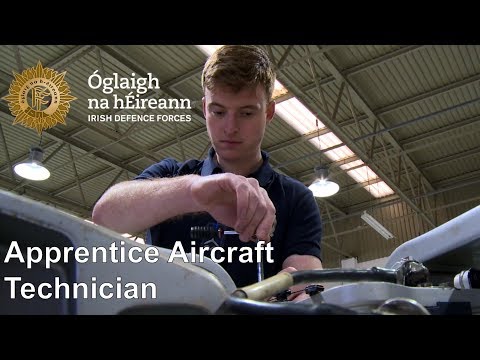
Air Corps Apprentice Aircraft Technician
Óglaigh na hÉireann / Irish Defence Forces
Required Education
Entry to the Air Corps Technician role is through a competitive Defence Forces recruitment process, and candidates typically hold a Leaving Certificate with subjects such as Engineering, Physics, Mathematics and Applied Mathematics being advantageous. Successful recruits undertake a structured military aircraft maintenance apprenticeship at Casement Aerodrome, leading to an NFQ Level 6 award in Aircraft Maintenance. The apprenticeship, which is managed in conjunction with SOLAS and industry partners, covers airframes, engines and avionics over several years of practical and theoretical training. No prior third-level degree is required for entry; the apprenticeship itself is the primary qualification route, combining earn-and-learn military service with certified technical training. On completion, technicians are qualified to certify maintenance work in line with Irish aviation regulations and Defence Forces standards.
Required Skills
Career Perspective
You typically begin as an apprentice technician at Casement Aerodrome, spending several years qualifying across one or more aircraft trade specialisations such as airframes, engines or avionics. On completion of the apprenticeship you serve as a qualified technician, taking on greater responsibility for certifying maintenance and mentoring junior colleagues as you gain rank within the Air Corps NCO structure. With experience and continued professional development you can progress to senior NCO grades, technical supervisory roles, or apply your qualifications to civilian aviation maintenance positions with airlines or MRO (maintenance, repair and overhaul) organisations, where your NFQ Level 6 award and military experience are recognised. Some technicians pursue further qualifications, including EASA Part-66 aircraft maintenance licences, to expand their career options in the broader Irish and European aviation industry.
AI Impact on the job
AI-assisted diagnostic tools and predictive maintenance software are increasingly used in aviation, helping technicians identify potential faults before they become critical and reducing unplanned downtime. These technologies augment rather than replace the technician's role, as physical inspection, repair and airworthiness sign-off still require qualified human judgement and hands-on skill. Air Corps Technicians will need to develop familiarity with data-driven maintenance systems and digital technical documentation platforms as these become standard across military and civilian fleets. Overall, AI is likely to make the role more efficient and technically demanding rather than reducing the need for skilled technicians.
Career Ladder
→ Air Corps Technician (Current role)
Related Studies
Aircraft Maintenance Apprenticeship
4 year • Tech & Engineering
ApprenticeshipElectrical Apprenticeship
4 year • Tech & Engineering
ApprenticeshipMechanical Automation and Maintenance Fitting Apprenticeship
4 year • Tech & Engineering
ApprenticeshipInstrumentation Apprenticeship
4 year • Tech & Engineering
BachelorDefence Forces Cadetship
4 year • Law & Public Administration
Employers in Ireland
Organisations in Ireland that employ people in this occupation.
Casement Aerodrome, Baldonnell, Co. Dublin
Primary employer; maintains, inspects and repairs all military aircraft.
Nationwide, HQ at Newbridge, Co. Kildare
Parent organisation recruiting and training all Air Corps Technicians.
Dublin Airport, Co. Dublin
MRO facility employing aircraft maintenance technicians on commercial fleets.
Dublin Airport, Co. Dublin
Aircraft maintenance and engineering for Aer Lingus fleet operations.
Dublin Airport and bases Nationwide
Employs licensed aircraft engineers maintaining large Boeing 737 fleet.
Dublin Airport and Nationwide
Regulates airworthiness; employs inspectors with aircraft maintenance backgrounds.
Shannon, Co. Clare
Airbus MRO and technical support operations requiring certified technicians.
Shannon, Co. Clare
Component overhaul and aircraft maintenance services at Shannon Airport.
Galway Airport, Co. Galway
Smaller MRO and charter operator maintaining light and turboprop aircraft.
Shannon, Co. Clare
Helicopter maintenance technicians supporting offshore and SAR operations.
We don't know whether these employers currently have vacancies — always check their own website. And if there's somewhere you'd really love to work, it can be worth applying anyway, even without an open vacancy.
Our tools can help you with that:
This website uses cookies
We use functional cookies and — with your consent — cookies for preferences, statistics and marketing.