Install Findmino as an app for the best experience!
Geology and Earth Science
Science & Mathematics
Duration
4 years
Level
Bachelor
Outlook
Growing
What will you learn?
Studying Geology and Earth Science at degree level gives you a thorough grounding in how the Earth formed, how it changes, and what resources it contains. You will cover topics such as mineralogy, petrology, structural geology, geophysics, hydrogeology and palaeontology, building both theoretical knowledge and strong practical skills. A significant part of your programme involves field mapping trips — often to locations around Ireland such as the west coast and Donegal, or further afield in Europe — where you learn to read landscapes and rock formations directly. Laboratory work includes identifying minerals and fossils, analysing geochemical data, and using GIS and remote-sensing software. In later years you typically undertake a research project or dissertation, and some programmes offer Erasmus placements or industry internships with consultancies or state bodies.
Videos about Geology and Earth Science
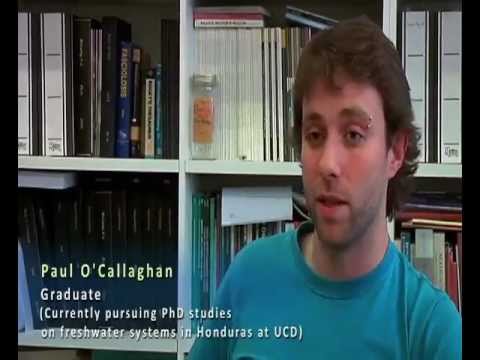
MSc Environmental Science (University College Dublin)
Required Education
Entry is through the CAO and typically requires a Leaving Certificate with a minimum of six subjects including English. Higher-level Maths and at least one science subject such as Chemistry, Physics or Biology are strongly advised, and competitive points tend to be moderate to high depending on the institution and intake year. Geography at Higher level is useful background but is not usually a formal requirement. Students who do not meet direct entry requirements can progress through a QQI Level 5 or 6 Science course at a College of Further Education, with many institutions offering guaranteed or competitive places for QQI applicants. Mature applicants aged 23 or over may apply through the mature student pathway, and HEAR and DARE schemes provide additional access routes for eligible students with socioeconomic or disability circumstances.
Core Subjects
Career Prospects
Demand for geology graduates in Ireland has remained steady, with growing opportunities in areas such as groundwater resource management, geothermal energy, offshore wind site investigation and critical minerals exploration linked to the green transition. The construction and infrastructure sector also employs engineering geologists regularly, particularly on major national projects. Graduates with strong GIS, data analysis or geophysics skills are particularly sought after. Many graduates also pursue postgraduate study to specialise further or move into research and academic roles.
Impact of AI on this program
Artificial intelligence and machine learning are increasingly being applied in geology for tasks such as automated mineral identification from drill-core images, seismic data interpretation and predictive modelling of subsurface structures. As a geology graduate you will be expected to work alongside these tools rather than be displaced by them, since field judgement, contextual interpretation and on-site assessment remain fundamentally human skills. Training in geospatial data analysis and digital subsurface modelling is already embedded in many Irish programmes to prepare you for a data-rich working environment. AI is likely to make geoscientists more efficient rather than reduce demand for qualified professionals.
CAO courses & points
1 CAO course lead to this qualification. Points shown are last year's Round 1 score.
Where can you study this?Providers and indicative points are curated with AI support. Always double-check with the institution itself.
Providers and indicative points are curated with AI support. Always double-check with the institution itself.
CAO points (indicative): 350-480 (2024)
* Indicative only: CAO points change every year. Always check the current points on cao.ie and with the institution.
How to apply
Applications for these honours bachelor degree programmes are made through the CAO (www.cao.ie) by 1 February each year; note that UCD and TCD use broad science entry codes from which students stream into Geology/Earth Science after first year, while UCC and University of Galway offer more direct entry into Earth Science-related programmes.
Possible Job Matches
Right after this study
Jobs you qualify for immediatelyGeologist
€35,000 - €85,000
ProfessionalEnvironmental Scientist
€32,000 - €75,000
ProfessionalHydrologist
€35,000 - €80,000
ProfessionalSoil Scientist
€32,000 - €75,000
ProfessionalSoil Survey Technician
€28,000 - €52,000
ProfessionalGeographer
€32,000 - €75,000
ProfessionalRemote Sensing Technician
€32,000 - €65,000
Growth opportunities
Roles you can grow into with experience or further studyDiscover more on Findmino
Other studies, careers, ideas and blogs you might not know yet.
This website uses cookies
We use functional cookies and — with your consent — cookies for preferences, statistics and marketing.