Install Findmino as an app for the best experience!
Marine Biologist
(Marine Scientist, Marine Ecologist, Aquatic Biologist, Oceanographer)
Science & Research
Salary
€28,000 - €75,000/yr
Level
Professional
Outlook
Growing
Sector
Science & Research
What does a Marine Biologist do?
As a Marine Biologist you study living organisms in the sea and ocean, examining how fish, invertebrates, marine mammals, seaweeds and microscopic organisms interact with one another and with their underwater environments. Your day-to-day work involves conducting field surveys and diving expeditions, collecting water and biological samples, and analysing data back in the laboratory. You use specialised scientific equipment to measure water quality, temperature, salinity and biodiversity, and you present your findings through written reports and published research papers. Marine Biologists in Ireland work closely with environmental agencies, government bodies, aquaculture companies and international research partners, contributing to fisheries management, conservation policy and climate change research.
A Day in the Life
Listen: a day as a Marine Biologist
You arrive at the Marine Institute's research facility in Galway at 07:30, pulling on waterproof gear before the morning briefing. Your team lead runs through the day's plan: a boat survey off the Connemara coast to collect water-quality samples and record seagrass bed coverage. You check the weather forecast on Met Éireann's marine service, confirm the inflatable research vessel is fuelled, and load the cool boxes, sample jars, GPS logger and a YSI multiparameter probe, which measures temperature, salinity and dissolved oxygen simultaneously. By 09:00 you are on the water. At each pre-agreed station you lower the probe, wait for the readings to stabilise, then enter the figures into a waterproof field notebook before transferring them to your tablet. You take water samples at depth using a Niskin bottle, labelling every container with a site code, time and depth. The work is methodical and slow, and a strengthening Atlantic swell makes it harder than it looks in the job description.
Videos about Marine Biologist
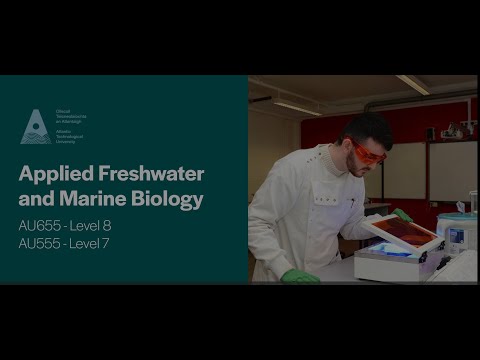
AU655 & AU555 Applied Freshwater & Marine Biology
ATU Galway City
Required Education
A strong Leaving Certificate with Higher Level Biology, Chemistry and Mathematics is the typical starting point for entry into marine science. Most Marine Biologists in Ireland hold an Honours Bachelor degree (NFQ Level 8) in Marine Biology, Zoology, Marine Science or a related discipline, with University of Galway and UCC offering well-regarded programmes with strong research links to the Marine Institute. Many progress to a Master's degree (NFQ Level 9) or PhD (NFQ Level 10), particularly those aiming for academic or senior research roles. PLC courses in Science at Level 5 or 6 can provide an alternative route into the field before progressing to a Level 7 or Level 8 degree via the CAO or through recognition of prior learning. Professional development is ongoing through bodies such as the Marine Institute and internationally recognised scientific associations, though there is no single statutory registration body for marine biologists in Ireland.
Required Skills
Career Perspective
Most Marine Biologists begin their careers in Ireland as research assistants or technicians, often attached to a university research group, the Marine Institute in Galway, or an environmental consultancy. With postgraduate qualifications and a growing publication record, you can progress to positions such as Research Scientist or Project Leader, taking responsibility for securing funding and managing research teams. Senior roles include Principal Investigator, Marine Ecologist with the EPA or Bord Iascaigh Mhara, or specialist consultant to government on fisheries and coastal management policy. Those with entrepreneurial ambitions may move into aquaculture technology companies, environmental impact assessment firms or offshore energy consultancies operating around Ireland's Atlantic coast.
AI Impact on the job
Artificial intelligence is transforming the way Marine Biologists process and interpret the vast quantities of data generated by ocean sensors, satellite imagery and underwater cameras, with machine learning tools now capable of identifying species and tracking population changes far faster than manual methods allow. AI-assisted modelling is improving the accuracy of predictions about ecosystem change under different climate scenarios, freeing researchers to focus on experimental design and policy interpretation. Routine tasks such as image classification, water quality monitoring and biodiversity counts are increasingly being automated, meaning that Marine Biologists who are comfortable working with data science tools and programming languages will have a significant advantage. The core scientific judgement, fieldwork expertise and ability to communicate findings to policy makers remain distinctly human strengths that AI cannot replace.
Career Ladder
→ Marine Biologist (Current role)
Related Studies
Employers in Ireland
Organisations in Ireland that employ people in this occupation.
Rinville, Oranmore, Co. Galway
Ireland's national marine research and monitoring agency.
Cork City
Marine biodiversity research, coastal ecology and ocean science programmes.
Galway City
Marine and coastal research covering biodiversity, fisheries and climate impacts.
Clonakilty, Co. Cork / Nationwide
Supports sustainable Irish seafood industry through marine science expertise.
Wexford / Nationwide
Monitors water quality, marine pollution and coastal environmental compliance.
Nationwide
Surveys and protects marine habitats, species and designated conservation sites.
Dublin 2
Zoology and marine ecology research including invertebrates and seagrass habitats.
Co. Mayo / Co. Donegal
Marine biologists monitor fish health, sea-lice and environmental impact.
Cork / Galway / Nationwide
Interdisciplinary marine and renewable energy research across Irish institutions.
Citywest, Dublin / Nationwide
Monitors diadromous fish species, estuarine ecosystems and water biodiversity.
Dublin / Cork / Galway
Environmental consultancy conducting marine surveys for planning and EIAs.
We don't know whether these employers currently have vacancies — always check their own website. And if there's somewhere you'd really love to work, it can be worth applying anyway, even without an open vacancy.
Our tools can help you with that:
This website uses cookies
We use functional cookies and — with your consent — cookies for preferences, statistics and marketing.