Install Findmino as an app for the best experience!
Automotive Engineering and Transport Management
Tech & Engineering
Duration
4 years
Level
Bachelor
Outlook
Growing
What will you learn?
Automotive Engineering and Transport Management combines vehicle technology with fleet and logistics management, preparing you for a rapidly evolving industry. You study mechanical and electrical engineering principles alongside diagnostic systems, vehicle dynamics, and modern drivetrain technologies including electric and hybrid powertrains. Modules in transport planning, fleet operations, and supply-chain management give the course a strong business dimension. Practical work is central: you spend time in well-equipped workshops carrying out diagnostics, fault-finding, and component analysis, and many programmes include an industry placement with employers such as vehicle dealerships, fleet operators, or transport companies. A typical week mixes workshop sessions, engineering laboratory work, and lectures in management or logistics.
Videos about Automotive Engineering and Transport Management
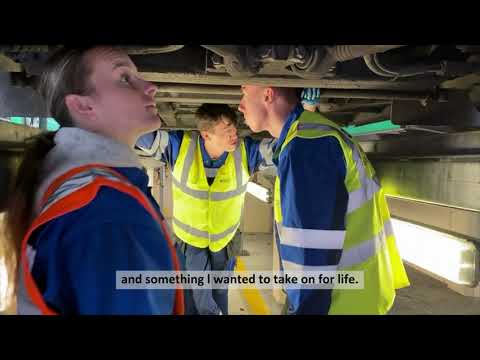
Hollie, a 1st Year Mechanic Apprentice - shares her thoughts on joining a male dominated industry.

Logistics Associate Apprenticeship
Required Education
Entry to the honours degree (NFQ Level 8) typically requires a Leaving Certificate with passes in Mathematics and English or Irish, though Higher-Level Mathematics is a significant advantage and is strongly recommended. Physics or Engineering is a useful subject. CAO points for this programme are generally moderate compared to traditional engineering degrees. A very common route is to complete an NFQ Level 6 Higher Certificate or a QQI Level 5/6 PLC in Engineering or Automotive Technology at a College of Further Education, then progress to Year 2 or Year 3 of the degree through a recognised link arrangement. Mature applicants (aged 23 or over) may apply directly through the CAO mature-student scheme, and HEAR and DARE access schemes are available at all participating institutions.
Core Subjects
Career Prospects
Demand for graduates with combined engineering and transport management skills is growing steadily in Ireland, driven particularly by the electrification of vehicle fleets and national targets for EV adoption. The transition away from internal-combustion engines is creating strong demand for engineers who understand both traditional diagnostics and modern electric and hybrid systems. Graduates with fleet management competencies are also sought by logistics companies expanding operations in Ireland. Starting salaries in the region of €32,000–€40,000 are typical, rising considerably with experience and specialisation.
Impact of AI on this program
Artificial intelligence is already reshaping automotive engineering through predictive diagnostics, autonomous driver-assistance systems, and connected-vehicle data platforms, all of which feature in updated curricula. AI-driven fleet management tools can optimise routing, maintenance scheduling, and fuel or energy consumption, skills that graduates are increasingly expected to understand and apply. While AI automates some routine diagnostic tasks, the need for qualified engineers to interpret complex data, validate systems, and manage physical infrastructure remains strong. Familiarity with data analytics and AI-assisted diagnostic software is becoming a standard expectation in the industry.
CAO courses & points
3 CAO courses lead to this qualification. Points shown are last year's Round 1 score.
Automotive Engineering and Transport Management
Technological University of the Shannon · Limerick
US915 · NFQ 8
Automotive Technology and Management
Munster Technological University · Cork
MT747 · NFQ 7
Automotive Management and Technology
Technological University Dublin · Bolton Street
TU720 · NFQ 7
Where can you study this?Providers and indicative points are curated with AI support. Always double-check with the institution itself.
Providers and indicative points are curated with AI support. Always double-check with the institution itself.
CAO points (indicative): 260-400 (2024)
* Indicative only: CAO points change every year. Always check the current points on cao.ie and with the institution.
How to apply
Applications for undergraduate BEng/BSc (Hons) programmes at Irish technological universities are made through the CAO (cao.ie) by the February 1st normal closing date, with Leaving Certificate points determining entry. Some providers may also consider mature student, FETAC/QQI further education, or advanced entry routes applied for directly through the institution.
Possible Job Matches
Right after this study
Jobs you qualify for immediatelySimilar Studies
Aircraft Systems Engineering
This programme focuses on the engineering principles underpinning aircraft airframe structures, propulsion systems and avionics, giving you a solid...
4 years
BachelorArchitectural Technology
Architectural Technology focuses on the technical design and construction of buildings, bridging the gap between architecture and engineering. You...
4 years
Discover more on Findmino
Other studies, careers, ideas and blogs you might not know yet.
This website uses cookies
We use functional cookies and — with your consent — cookies for preferences, statistics and marketing.